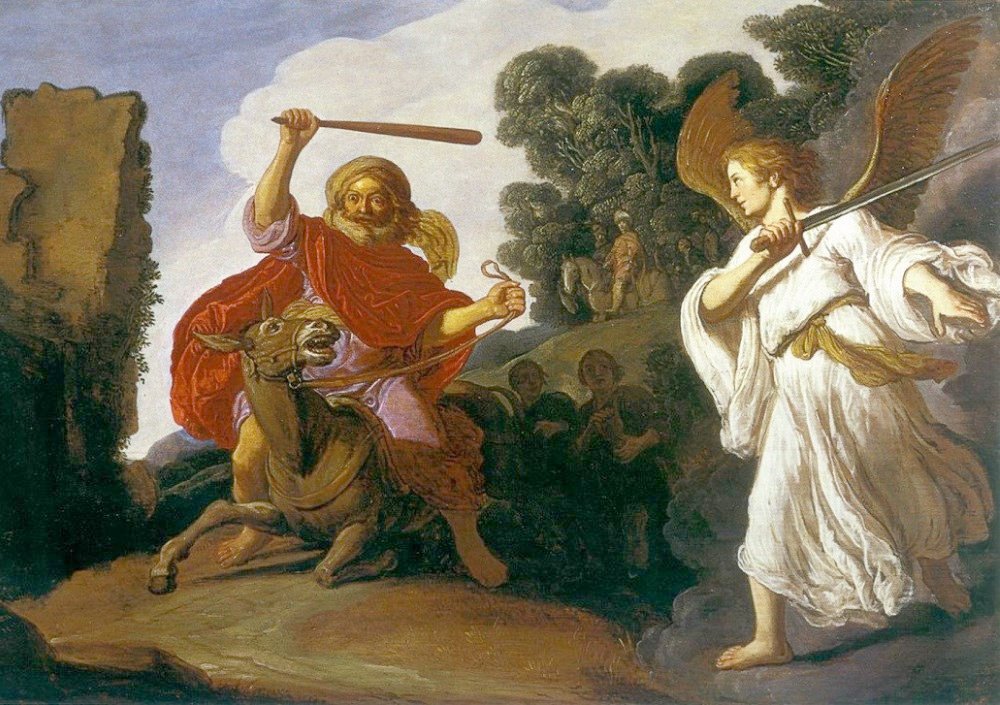
Balaam and the Ass (adapted), by Pieter Lastman 1622, Wikimedia

Series
Balaam and the Ass (adapted), by Pieter Lastman 1622, Wikimedia
King Balak of Moab invites Balaam, a well-known prophet or sorcerer, to come to Moab and curse the Israelites, who have encamped in or near his territory.[1] His first set of messengers fail to convince Balaam to come; Balaam then asks God—with whom he communicates in dreams and visions—for permission, but God refuses. Balak then sends another delegation of even more prominent messengers, and Balaam again responds that they should spend the night, as he must commune with God to ask permission.
במדבר כב:כ וַיָּבֹא אֱלֹהִים אֶל בִּלְעָם לַיְלָה וַיֹּאמֶר לוֹ אִם לִקְרֹא לְךָ בָּאוּ הָאֲנָשִׁים קוּם לֵךְ אִתָּם וְאַךְ אֶת הַדָּבָר אֲשֶׁר אֲדַבֵּר אֵלֶיךָ אֹתוֹ תַעֲשֶׂה.
Num 22:20 That night God came to Balaam and said to him, “If these men have come to invite you, you may go with them. But whatever I command you, that you shall do.”
In light of this permission, God’s reaction to Balaam following Balak’s delegation in the next two verses is surprising:
במדבר כב:כא וַיָּקָם בִּלְעָם בַּבֹּקֶר וַיַּחֲבֹשׁ אֶת אֲתֹנוֹ וַיֵּלֶךְ עִם שָׂרֵי מוֹאָב. כב:כבוַיִּחַר אַף אֱלֹהִים כִּי הוֹלֵךְ הוּא וַיִּתְיַצֵּב מַלְאַךְ יְ־הוָה בַּדֶּרֶךְ לְשָׂטָן לוֹ…
Num 22:21 When he arose in the morning, Balaam saddled his donkey and departed with the Moabite dignitaries. 22:22 But God was incensed at his going; so an angel of YHWH placed himself in his way as an adversary….
While Balaam doesn’t see the divine messenger (angel), the donkey does, and veers away from the angel’s sword three times. Balaam becomes angry with the donkey and strikes it, to which the donkey responds with a verbal complaint—which, oddly enough, neither surprises Balaam nor calms his wrath. Eventually, the angel appears to Balaam, and he apologizes for his treatment of the donkey, after which the angel repeats God’s message from the dream, and Balaam continues on to meet Balak.
Before turning to understand this fantastic account, we must ask a basic and preliminary question: Why is God incensed at Balaam’s going when in the previous verse God granted him permission?
Some traditional commentators tried to answer the problem by suggesting that God was angry about Balaam’s intentions. For instance, the peshat commentator, Rashbam (Samuel ben Meir, ca. 1085–1158) writes:
"כי הולך הוא"—ברצון, מתאוה לקללם, אף על פי שהיה יודע שאין הקב”ה רוצה.
“At his going”—willingly, with a yearning to curse them, even though he knew that the Holy One, blessed be he, does not want [them cursed].
Other commentators suggest that the sin was that Balaam believed God would change his mind and allow him to curse the Israelites.[2] The text itself, however, gives no hint of Balaam’s sinful intentions or any example of his attempt to convince God to change his made. Consequently, many critical scholars have taken a different approach.
For over a century, most biblical scholars have appealed to the Documentary Hypothesis, according to which narrative inconsistences are a result of the splicing together of different, parallels sources. The standard approach, as summarized by Julius Wellhausen, was to see the dream revelation allowing Balaam to go as part of E, and the account of God being incensed and sending an angel to stop him as J.[3]
Further support for these being two parallel accounts is that the angel’s message is the same as God’s message in the dream account (v. 20):
The Dream
במדבר כב:כ וַיָּבֹ֨א אֱ-לֹהִ֥ים׀ אֶל־בִּלְעָם֘ לַיְלָה֒ וַיֹּ֣אמֶר ל֗וֹ אִם־לִקְרֹ֤א לְךָ֙ בָּ֣אוּ הָאֲנָשִׁ֔ים ק֖וּם לֵ֣ךְ אִתָּ֑ם וְאַ֗ךְ אֶת־ הַדָּבָ֛ר אֲשֶׁר־אֲדַבֵּ֥ר אֵלֶ֖יךָ אֹת֥וֹ תַעֲשֶֽׂה:
Num 22:20That night God came to Balaam and said to him, “If these men have come to invite you,you may go with them. But whatever I command you, that you shall do.”
The Angel
במדבר כב:לה וַיֹּאמֶר֩ מַלְאַ֨ךְ יְ-הֹוָ֜ה אֶל־בִּלְעָ֗ם לֵ֚ךְ עִם־הָ֣אֲנָשִׁ֔ים וְאֶ֗פֶס אֶת־הַדָּבָ֛ר אֲשֶׁר־אֲדַבֵּ֥ר אֵלֶ֖יךָ אֹת֣וֹ תְדַבֵּ֑ר וַיֵּ֥לֶךְ בִּלְעָ֖ם עִם־שָׂרֵ֥י בָלָֽק:
Num 22:35But the angel of YHWH said to Balaam, “Go with the men. But you must say nothing except what I tell you.” So Balaam went on with Balak’s dignitaries.
The medieval commentator, Don Isaac Abravanel (1437–1508) already noted this problem (question 19, ad loc.).
על מה יצא מלאך י”י לבלעם בדרך? כי הנה הוא לא אמר לא אלא דוגמת מה שאמר לו יתברך…. והיתה אם כן ביאתו לבטלה.
Why did the angel of God confront Balaam in the wilderness? He only tells him exactly what God had already told him…. Thus his appearance seems superfluous.
The angel’s action does not move the story forward at all, which is good evidence that it is not part of the dream story but something else. Nevertheless, the argument that the story is part of a separate source is problematic since all attempts at recreating two complete coherent narratives from Numbers 22:2–24:25 have yielded choppy incoherent partial texts.[4]
Although it is not impossible that parts of E and J were lost or cut in the editing process, or that future attempts will uncover a more coherent division, a more generative approach to the problem is a supplementary one. This was first suggested in a detailed study of the Balaam narrative by Marcus Kalisch (1828–1885), who studied at the University of Berlin and received his Ph.D. from Halle before immigrating to England, where he eventually served as the tutor to the Rothschild family. Immensely erudite, his perspectives became more in line with critical scholarship over the years, and he was a strong advocate for the supplementary hypothesis, namely that a basic Torah text was supplemented over time by various tradents.
Writing before Wellhausen published his two-source reconstruction, Kalisch noted the contradictions between it and the verses preceding it, and, dismissing any attempt to harmonize the account as it stands, concludes that the donkey story was not originally part of the Balaam story, but was added into the account at a later date.[5] (His dating of the supplement and the reason for it is discussed below.)
If the story is a later supplement, then the similarity between verses 20 and 35 is not a consequence of splicing together parallel accounts but of a an editorial technique known as Wiederaufnahme (resumptive repetition), which refers to when an author or editor ends an excursus or supplementary insertion by paraphrasing the text immediately preceding the digression, to bring the reader back into the storyline.[6]
In other words, in the original text, God tells Balaam in a dream that he may go with the men, which he does, and the story continues with verse 35b, “and Balaam went with Balak’s ministers” (וַיֵּלֶךְ בִּלְעָם עִם שָׂרֵי בָלָק). A later scribe, however, added the story about the donkey and the angel, and then, to return the narrative to its proper flow, ended the new anecdote by having the angel paraphrase God’s earlier message: go with these men but say only what YHWH tells you to.
Less than two decades after Kalisch published his work, Paul Volz (1871–1941), a German scholar apparently unaware of Kalisch’s thesis, also argued that the donkey story was a supplement.[7] Based on philological evidence, he argued, like Kalisch, that the supplement was a late addition, from the Second Temple Period. While Heinrich Holzinger (1863–1944) pushed against this claim, arguing that the language of the donkey story exhibits no signs of late Hebrew,[8] Volz was undoubtedly correct.
The text uses a number of unique words (hapax legomena) or expressions found (virtually) nowhere else in the Bible:
The text also has three unusual usages of terms:
This unusual, awkward and stilted Hebrew suggests the possibility that the author was not a native Hebrew speaker but an Aramaic speaker doing his best to mimic classical Hebrew prose.
Volz’s philological considerations lead us to a Second Temple Period dating for the story. Kalisch suggested this same dating but for ideological reasons. Kalish claimed that this late supplement was part of an attempt to rehabilitate Balaam the prophet, whose reputation, he believes, suffered at the hands of later exegetes. To make this argument, he brings forward many midrashic treatments of Balaam in Jewish and Christian literature that skewer the outsider prophet, and attach every form of baseness and iniquity to him they could find.
He argues that the original Balaam tradition was about a true prophet who announces from the beginning that he will only say that which God puts in his mouth, who despises silver and gold, and speaks the truth brazenly to a king without concern.
The original author, Kalisch argues, was thus working with a consciousness of the oneness of humanity, and believed in the ability of non-Israelites to know God, similar to the way Melchizedek in Genesis 14 was a priest to the Most-High God. This humanistic, international spirit was characteristic of the golden age of Israel, namely the time of David and Solomon, in which period, Kalish argues, the core Balaam account was composed.[10]
The donkey incident, Kalisch notes, differs in spirit from the rest of the account in this regard, and was added into the account by a later scribe to blacken Balaam’s reputation. For this reason, Kalisch dates the supplement to the Second Temple Period, when Judaism was introverted, developing laws that sharply divided between Jews and gentiles.
With the addition of the donkey story, the reader learns to second-guess Balaam’s relationship with YHWH. Like the traditional commentators referenced above, Kalisch argues that if Balaam undertook the journey to Moab and an angel of God appeared sword in hand to kill him, then his intentions could not have been pure. But in this latter account, he was seduced by gold, silver, and honor to curse Israel and for this reason YHWH became angry with him.
The author of the donkey account presents the wicked impulse of this diviner, a form of spiritual blindness, through the image of physical blindness. Balaam literally cannot see YHWH’s intention, even though it stands before Balaam in the form of an angel bent on his destruction. The humiliation he faces when rebuked first by his own donkey then by an angel of God who almost killed him, is a natural consequence of—as well as punishment for—being seduced by Balak’s offer, a sign of his greediness and spiritual weakness.[11]
Nevertheless, since Balaam will have to bless Israel, according to the story, the author is forced to allow him to repent. Balaam admits his sins (22:34), such as striking the donkey and being blind to the angel, and is warned yet again to only say that which YHWH tells him.
Kalisch’s approach has a homiletical predisposition, which wishes to reveal in the more ancient strata of the Bible a spirit of international brotherhood and camaraderie. This predisposition, which is certainly part of the reason his views have been overlooked, are responsible for his exaggerated evaluation of the international spirit of the core Balaam account and its supposed elevated prophetic universalism, which declares the end of paganism and the united worship of YHWH by all peoples. Moreover, Kalisch reads things into the supplemental donkey story that are absent, such as Balaam’s lust for gold, silver, and honor.
In these respects, Kalisch’s analysis veered away from the simple meaning of the text. Nevertheless, we can build upon his core observation that the story is a supplement and that it contradicts the main thrust of the core narrative, while explaining the purpose of the addition differently.
Kalisch is correct that the donkey episode is meant to lampoon Balaam, for, as many commentators have already noted, the episode is full of irony.[12] Balaam, the esteemed speaker of oracles, whose words have power, and about whom Balak says, “whomever he blesses is blessed and whomever he curses is cursed” (אֵת אֲשֶׁר תְּבָרֵךְ מְבֹרָךְ וַאֲשֶׁר תָּאֹר יוּאָר; Num 22:6), now cannot even master his own donkey, and needs to literally pick up his staff and hit him repeatedly—to no avail.
Midrash Tanchuma had already noted this irony (Balak 13, Buber ed.):
משל לרופא שבא לרפאות בלשונו נשוך הנחש בדרך, ראה אנקה בדרך, התחיל מבקש מטה להורגה, אמרו לו זה אין אתה יכול ליטול, האיך באתה לרפאות בלשונך נשוך נחש, כך אמרה האתון לבלעם לי אין אתה יכול להרגני, אלא אם כן יש חרב בידך, והיאך אתה רוצה לעקור אומה שלימה, שתק ולא מצא תשובה, התחילו תמיהים שרי מואב, שראו נס שלא היה כמותו בעולם.
This can be compared to a doctor who comes to cure with an incantation a man who was bit by a venomous snake. On the way, he sees a gecko and begins to look for a stick with which to kill it. They said to him: “You can’t catch this creature, how do you expect to cure someone of a venomous snake bite with an incantation?” This is what the donkey said to Balaam: “You can’t even kill me, how do you expect to uproot an entire nation.” [Balaam] was silent and could find no answer. The noblemen of Moab became shocked, since they saw a miracle (=a talking animal) the likes of which had never occurred before.
While the great speaker of oracles took recourse in brute strength, the simple animal teaches him wisdom, by posing to him a wisdom-style pedagogical question.[13]
Balaam, the famous seer, who congratulates himself with the claim that מַחֲזֵה שַׁדַּי יֶחֱזֶה “he sees the visions of Shaddai” (24:4, 16) and that אֶרְאֶנּוּ וְלֹא עַתָּה אֲשׁוּרֶנּוּ וְלֹא קָרוֹב “what I see for them is not yet, what I behold will not near at hand” (Num 24:16) is unable to see—three times in a row!—what his own donkey can see clearly. The man who began his poetic oracles נֹפֵל וּגְלוּי עֵינָיִם “prostrate, but with eyes unveiled” (Num 24:4), describing the incredible reach of his ecstatic vision, is now described as unable to see what is in front of him until “YHWH opened the eyes of Balaam” (וַיְגַל יְ־הוָה אֶת עֵינֵי בִלְעָם; Num 22:31).[14]
Balaam, the wise man מֵהַרְרֵי קֶדֶם, from eastern mountains (Num 23:7), who takes pride in the fact that he שֹׁמֵעַ אִמְרֵי אֵל וְיֹדֵעַ דַּעַת עֶלְיוֹן “hears God’s speech and knows the knowledge of the Most High” (Num 24:16) must, upon encountering the angel of YHWH on the road, declare חָטָאתִי כִּי לֹא יָדַעְתִּי “I have sinned, for I did not know” (Num 22:34). Regarding this, the Sages expounded (Tanchuma, Balak 10):
אף על פי שמשתבח אותו רשע ואומר ויודע דעת עליון פיו העיד בו ואמר לא ידעתי.
Even though that wicked person boasts by saying “he knows the knowledge of the Most High,” his own mouth testifies against him, and he says “I didn’t know.”
The story of the donkey mocks Balaam’s character traits as they are described in the Balaam account, particularly in the very ancient speeches of chapter 24. The mockery is expressed by presenting Balaam’s weakness: he cannot control his own donkey, does not understand what is happening, and cannot even see the angel standing before him. In his anger—and having a character lose his temper is a classic way of portraying weakness and foolishness—he tries to teach his donkey obedience by hitting it with his staff (Num 22:27), but instead the donkey teaches him a lesson with its words.[15]
The mockery of Balaam is presented as the inverse of his positive traits as laid out in the main narrative and the ancient poems. This reveals the essential purpose of the donkey story: it is a burlesque that was composed to mock Balaam by putting the spotlight on his so-called positive traits (vision, understanding, power) and showing that these are of no help to him; even a donkey possesses these traits and benefits from them![16]
The fact that the burlesque plays off the words in the poems of chapter 24 shows that the former is literarily dependent on the latter.[17] This fits well with the purpose of the story as it was only in a later period, starting with the Deuteronomists, that biblical authors and scribes wished to rid themselves of any positive reflections on this foreign prophet.[18]
The donkey story does this through a form of mockery that turns Balaam’s most significant features as a seer into objects of ridicule, presenting him as a pathetic, irascible, and oblivious fool called to account before one of God’s angels by his own donkey. Thus, the story shrinks his stature and belittles his legacy.
A similar outlook is reflected by the Priestly author of Joshua 13:22, who refers to Balaam using the pejorative term “sorcerer” (קוסם), and by the scribes who added the element of the Midianites with “sorcery in their hands” (וקסמים בידם) appearing before Balaam to convince him to curse Israel, into the Balaam story itself (Num 22:7).[19]
The line of interpretation which began here and in other late parts biblical literature, continues in midrashic literature. For the rabbis, however, the book of Numbers was canonical, so they could not question Balaam’s prophetic abilities. Rather, they claimed that his case was unique because he was the prophet to the gentiles, which, they argue, was necessary for a variety of theological reasons.
Thus, the rabbis did not accept Balaam as a person worthy of respect. In fact, they take the donkey story’s burlesque presentation and run with it (b. Sanhedrin 105a):
מר זוטרא אמר: "קוסם באמתו היה." מר בריה דרבינא אמר: "שבא על אתונו.”
Mar Zutra said: “He would divine using his phallus.” Mar the son of Ravina said: “He had intercourse with his donkey.”
These statements are meant to make Balaam look ridiculous, but they do not deny that he had power. Thus, instead of impugning his abilities, which were enshrined in the text, the rabbis concentrated their polemic on questioning his moral stature.
Scholars have long noted the donkey story’s primitive, folkloristic attributes: the anthropomorphism of the divine messenger, the naïve depiction of a talking animal, and the thrice repeated mockery of an important personage. These are all correct observations, but the corollary assumption of some scholars, that this must therefore be a very ancient text, is incorrect, as these same elements are made use of in other forms of literature as well, late as well as early.[20]
Most importantly, the sustained mockery of Balaam is not a folkloristic holdover but is the very point of the story. The donkey account was written to insult the non-Israelite prophet specifically in the very traits that he was best known for and most proud of. The upshot of the story is that Balaam does not really “know the knowledge of the Most High” (ידע דעת עליון), nor is he actually “one with eyes unveiled” (גלוי עינים), rather, he is blind to God’s messenger and dumber than an ass.
TheTorah.com is a 501(c)(3) nonprofit organization.
We rely on the support of readers like you. Please support us.
Published
July 17, 2019
|
Last Updated
September 11, 2026
Footnotes
Published
July 17, 2019
|
Last Updated
September 11, 2026
[1] This article is based upon sections 8, 9, 11, and 13 of, Alexander Rofé, “ספר בלעם”- (במדבר כ”ב, ב – כ”ד, כה) – עיון בשיטות הביקורת ובתולדות הספרות והאמונה [The Book of Balaam (Numbers 22.2-24.25): A Study in Methods of Criticism and the History of Biblical Literature and Religion], Jerusalem Biblical Studies 1 (Jerusalem: Simor, 1979). The piece was translated by Zev Farber and adapted for TheTorah.com in consultation with the author.
[2] See Joseph Bekhor Shor and Daat Zeqeinim ad loc.
[3] See, Julius Wellhausen, Die Composition des Hexateuchs und der Historischen Bücher des Alten Testaments (Berlin: G. Reimer, 1899), 110–111. See also, August Dillmann, Die Bücher Numeri, Deuteronomium, Joshua, KEHAT 2; (Leipzig: S. Hirzel, 1886), 136; Benjamin W. Bacon, The Triple Tradition of the Exodus (Hartford: The Student Publishing Company, 1894), 218–232; and among more contemporary scholars, Walter Groß, Bileam: Literatur- un formkritische Untersuchung der Prosa in Num 22-24 (Munich: Kösel-Verlag, 1974). Otto Eißfeldt even made the “Book of Balaam” into the parade example which proves the correctness of this division. See, Otto Eißfeldt, “Die Komposition der Bileam-Erzählung: Eine Nachprüfung von Rudolphs Beitrag zur Hexateuchkritik,” ZAW 57 (1939): 212–241.
[4] For a detailed look at the various options for reconstruction E and J, see section 1–4 of my The Book of Balaam.
[5] Marcus M. Kalisch, Bible Studies Part 1: The Prophecies of Balaam (Numbers xxii-xxiv), or the Hebrew and the Heathen (London: Longmans, Green, and Co., 1877).
[6] See, Harold M. Wiener, The Composition of Judges II, 11 to 1 Kings II, 46 (Leipzig: J.C. Hinrichs, 1929), 2; Curt Kuhl, “Die ‘Wiederaufnahme’ – ein literarkritisches Prinzip?” ZAW64 (1952): 1-11; Isaac L. Seeligmann, “Hebräische Erzählung und biblische Geschichtsschreibung,” ThZ (Basel) 18 (1962): 305–325 [314–324]. Wiener was the first critical scholar to note this phenomenon; Kuhl offered many examples of it in prophetic literature and Seeligmann did so in biblical narrative. Seeligmann further argued for differentiating between Wiederaufnahmen utilized by authors and those used by redactors, in contrast to the position of Yehezkel Kaufmann, The Book of Joshua with Commentary [in Hebrew] (Jerusalem: Kiryat Sepher, 1959), 76–77. Shemaryahu Talmon has also given much attention to the phenomenon; see Shemaryahu Talmon and Michael Fishbane, “Aspects of the Literary Structure of the Book of Ezekiel” [in Hebrew], Tarbiz 42 (5733): 27–41 [35ff]. See also Burke O. Long, “Framing Repetitions in Biblical Historiography,” Journal of Biblical Literature 106.3 (1987): 385–399; Ray Person, “A Reassessment of Wiederaufnahme from the Perspective of Conversation Analysis,” Biblische Zeitschrift 43 (1999): 241–248. Editor’s note: For a basic introduction to this technique, Zev Farber, “The Resumptive Repetition (Wiederaufnahme),” TheTorah.com (2014).
[7] He still accepted the documentary division however, and divided the passage between three authors.
Paul Volz, “Rezension von A. Freiherr von Gall, Zusammensetzung und Herkunft der Bileam-Perikope,” Theologische Literaturzeitung 26 (1901): cols. 383–385. This obscure article went unnoticed even by Volz’s student, Wilhelm Rudolph, who wrote extensively about the Balaam account and never mentioned it. A third early scholar who argued for the donkey story as a supplement was Max Löhr, who harshly criticized the documentary approach. See Max Löhr, “Bileam, Num 22, 2-24, 25,” Archiv für Orientforschung 4 (1927): 85–89. This article also went mostly unnoticed by his fellow scholars.
[8] Heinrich Holzinger, Numeri erklärt, KHAT (Tübingen und Leipzig: Mohr, 1903), 113–114.
[9] Rashbam attempts to distinguish between “from my presence” (מפני) and “before my presence” (לפני) to make אולי work in this context.
[10] See Kalisch, Prophecies of Balaam, 34–35.
[11] See Kalisch, Prophecies of Balaam, 139–140.
[12] Bruno Baentsch, Exodus, Leviticus, Numeri, Handkommentar zum Alten Testemant (Göttingen: Vandenhoeck & Ruprecht, 1903), 598; Julius A. Bewer, “Literary Problems of the Balaam Story,” American Journal of Theology 9 (1905): 238–262 [258]; Löhr, “Bileam,” 88; Wilhelm Rudolph, Der Elohist von Exodus bis Joshua, BZAW 68 (Berlin: De Gruyter, 1938), 110.
[13] Baentsch has a nice discussion of this point: see Exodus, Leviticus, Numeri, 598. See also Hugo Gressmann, Mose und seine Zeit: Ein Kommentar zu den Mose-Sagen (Göttingen: Vandenhoeck & Ruprecht, 1913), 323.
[14] Arnold Ehrlich, in his Miqra Kepheshutto (Gen 21:19) tries to distinguish between “revealing [to someone’s] eyes” (לגלות עינים), which appears here and in Psalms 119:18, and “to open [one’s] eyes.“ I do not believe this distinction holds water, and the opening of Adam and Eve’s eyes (פקח) is enough to disprove it. In truth, the phrase פקח עיניים in the Bible is also used to describe seeing something that the average person does not see (Gen 21:19, 2 Kgs 6:17, 20). It is just that in this case, the author chose the phrase “revealed to the eyes of…” (ויגל… את עיני) as an intertextual play: until YHWH revealed (גל) the angel to Balaam’s eyes (את עיני), Balaam was not really someone “with his eyes unveiled” (גילוי עינים), but rather, he could see even less than his donkey. Thus, it would seem to me that Mauchline got the order of intertextual play backwards when he argued that the use of the term in the poem was a play on its use in the donkey story. See, John Mauchline, “The Balaam-Balak Songs and Saga,” in Presentation Volume to W. B Stevenson, ed. C. J. Mullo Weir, Studie Semetica and Orientalia 2 (Glasgow: Glasgow University Oriental Society, 1945), 43–94.
[15] Compare Job 12:7, 35:11.
[16] This style of burlesque is utilized often in Aesop’s Fables, which will portray astrologers, diviners, and sorcerers failing in such ways. See discussion in, Yair Zakovitch, על שלושה ועל ארבעה: הדגם הספרותי שלושה-ארבעה במקרא [The Literary Device of 3-4 in the Bible] (PhD diss., Hebrew University of Jerusalem, 1978), 123–129 [108n41].
[17] I say this in contrast to Groß (Bileam, 367) who recognized no literary dependence of the donkey story on any part of the Balaam account, including the poems.
[18] For more on how Balaam turned from heroic character to villain over time, see my “How Balaam the Prophet of YHWH Became a Villain,” TheTorah.com (2019).
[19] Editor’s note: For an argument that the Midianites are redactional insertions into the story, see Itamar Kislev, “How Ancient Scribes Tried to Make Sense of the Composite Story of Baal Peor,” TheTorah.com (2014).
[20] For instance, rabbinic midrash makes use of divine anthropomorphism. Similarly, the motif of animals that turn out to be better than humans is characteristic of post-destruction (i.e., post-Second Temple) prophetic parables.

Prof. Alexander Rofé is Professor (Emeritus) of Bible at the Hebrew University of Jerusalem, where he held the Yitzhak Becker Chair in Jewish Studies and whence he received his Ph.D. in 1970. Among his many books are Angels in the Bible: Israelite Belief in Angels as Evidenced by Biblical Traditions (1979, reissued 2012), Prophetical Stories (1988), Introduction to the Composition of the Pentateuch(1999), and Deuteronomy: Issues and Interpretation (2002).